Download Ebook Probability, Statistics, and Random Processes For Electrical Engineering (3rd Edition), by Alberto Leon-Garcia
Probability, Statistics, And Random Processes For Electrical Engineering (3rd Edition), By Alberto Leon-Garcia. The established innovation, nowadays assist every little thing the human needs. It consists of the day-to-day tasks, jobs, office, amusement, and a lot more. One of them is the fantastic website connection and also computer system. This condition will certainly reduce you to support one of your pastimes, reviewing habit. So, do you have going to read this book Probability, Statistics, And Random Processes For Electrical Engineering (3rd Edition), By Alberto Leon-Garcia now?
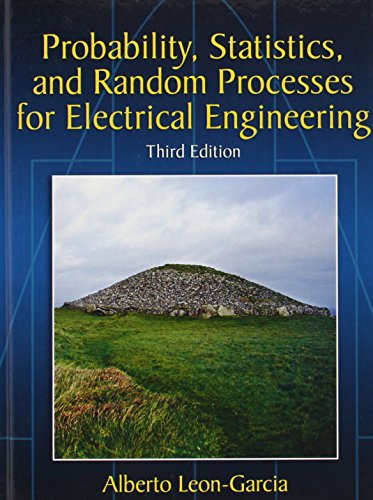
Probability, Statistics, and Random Processes For Electrical Engineering (3rd Edition), by Alberto Leon-Garcia

Download Ebook Probability, Statistics, and Random Processes For Electrical Engineering (3rd Edition), by Alberto Leon-Garcia
Do you think that reading is a crucial task? Find your reasons why including is necessary. Reviewing a publication Probability, Statistics, And Random Processes For Electrical Engineering (3rd Edition), By Alberto Leon-Garcia is one component of delightful tasks that will certainly make your life quality much better. It is not about just what sort of e-book Probability, Statistics, And Random Processes For Electrical Engineering (3rd Edition), By Alberto Leon-Garcia you check out, it is not simply about how several publications you check out, it's regarding the behavior. Reviewing practice will certainly be a method to make book Probability, Statistics, And Random Processes For Electrical Engineering (3rd Edition), By Alberto Leon-Garcia as her or his pal. It will certainly regardless of if they invest cash and spend more publications to complete reading, so does this e-book Probability, Statistics, And Random Processes For Electrical Engineering (3rd Edition), By Alberto Leon-Garcia
Right here, we have many publication Probability, Statistics, And Random Processes For Electrical Engineering (3rd Edition), By Alberto Leon-Garcia and collections to read. We additionally serve alternative types and sort of the publications to look. The enjoyable publication, fiction, past history, unique, science, as well as various other kinds of e-books are readily available below. As this Probability, Statistics, And Random Processes For Electrical Engineering (3rd Edition), By Alberto Leon-Garcia, it turneds into one of the preferred e-book Probability, Statistics, And Random Processes For Electrical Engineering (3rd Edition), By Alberto Leon-Garcia collections that we have. This is why you remain in the appropriate website to view the remarkable e-books to own.
It will not take more time to download this Probability, Statistics, And Random Processes For Electrical Engineering (3rd Edition), By Alberto Leon-Garcia It will not take more cash to publish this e-book Probability, Statistics, And Random Processes For Electrical Engineering (3rd Edition), By Alberto Leon-Garcia Nowadays, individuals have actually been so smart to utilize the innovation. Why don't you use your gadget or other gadget to conserve this downloaded and install soft documents publication Probability, Statistics, And Random Processes For Electrical Engineering (3rd Edition), By Alberto Leon-Garcia Through this will allow you to consistently be come with by this publication Probability, Statistics, And Random Processes For Electrical Engineering (3rd Edition), By Alberto Leon-Garcia Naturally, it will be the best friend if you review this e-book Probability, Statistics, And Random Processes For Electrical Engineering (3rd Edition), By Alberto Leon-Garcia till finished.
Be the first to download this publication now and get all reasons why you have to review this Probability, Statistics, And Random Processes For Electrical Engineering (3rd Edition), By Alberto Leon-Garcia The book Probability, Statistics, And Random Processes For Electrical Engineering (3rd Edition), By Alberto Leon-Garcia is not only for your duties or necessity in your life. Publications will always be an excellent friend in every time you review. Now, let the others understand about this web page. You could take the benefits as well as share it additionally for your buddies as well as individuals around you. By through this, you could truly obtain the significance of this publication Probability, Statistics, And Random Processes For Electrical Engineering (3rd Edition), By Alberto Leon-Garcia profitably. Just what do you think of our idea right here?
This is the standard textbook for courses on probability and statistics, not substantially updated. While helping students to develop their problem-solving skills, the author motivates students with practical applications from various areas of ECE that demonstrate the relevance of probability theory to engineering practice. Included are chapter overviews, summaries, checklists of important terms, annotated references, and a wide selection of fully worked-out real-world examples. In this edition, the Computer Methods sections have been updated and substantially enhanced and new problems have been added.
- Sales Rank: #366117 in Books
- Published on: 2008-01-07
- Original language: English
- Number of items: 1
- Dimensions: 8.90" h x 1.80" w x 7.00" l, 3.00 pounds
- Binding: Paperback
- 832 pages
From the Inside Flap
Probability and Random Processes for Electrical Engineering presents a carefully motivated, accessible, and interesting introduction to probability and random processes. It is designed to allow the instructor maximum flexibility in the selection of topics. In addition to the standard topics taught in introductory courses on probability, random variables, and random processes, the book includes sections on modeling, basic statistical techniques, computer simulation, reliability, and entropy, as well as concise but relatively complete introductions to Markov chains and queueing theory.
The complexity of the systems encountered in electrical and computer engineering calls for an understanding of probability concepts and a facility in the use of probability tools from an increasing number of B.S. degree graduates. The introductory Course should therefore teach the student not only the basic theoretical concepts but also how to solve problems that arise in engineering practice. This course requires that the student develop problem-solving skills and understand how to make the transition from a real problem to a probability model for that problem. Relevance to Engineering Practice
Motivating students is a major challenge in introductory probability courses. Instructors need to respond by showing students the relevance of probability theory to engineering practice. Chapter 1 addresses this challenge by discussing the role of probability models in engineering design. Practical applications from various areas of electrical and computer engineering are used to show how averages and relative frequencies provide the proper tools for handling the design of systems that involve randomness. These application areas are used in examples and problems throughout the text. From Problems to Probability Models
The transition from real problems to probability models is shown in several ways. First, important concepts are usually developed by presenting real data or computer-simulated data. Second, sections on basic statistical techniques are integrated throughout the text. These sections demonstrate how statistical methods provide the link between theory and the real world. Finally, the significant random variables and random processes are developed using model-building arguments that range from simple to complex. For example, in Chapter 2 and 3, text discussion proceeds from coin tossing to Bernoulli trials. It then continues to the binomial and geometric distributions, and finally proceeds via limiting arguments to the Poisson, exponential, and Gaussian distributions. Examples and Problems
Numerous examples in every section are used to demonstrate analytical and problem-solving techniques, develop concepts using simplified cases, and illustrate applications. The text includes over 700 problems, identified by section to help the instructor select homework problems. Additional sets of problems requiring cumulative knowledge are provided at the end of each chapter. Answers to selected problems are included at the end of the text. A Student Solutions Manual accompanies this text to develop problem-solving skills. A sampling of 25% of carefully worked out problems has been selected to help students understand concepts presented in the text. An Instructors Solutions Manual with complete solutions is also available. Computer Methods
The development of an intuition for randomness can be aided by the use of computer exercises. Appendix C contains computer programs for generating several well-known random variables. The resulting data from computer-generated random numbers and variables can be analyzed using the statistical methods introduced in the text.
Sections on computer methods have been integrated into the text rather than isolated in a separate chapter because performing the computer exercises during lessons helps students to learn basic probability concepts. It should be noted that the computer methods introduced in Sections 2.7, 3.11, and 4.10 do not necessarily require entirely new lectures. The transformation method in Section 3.11 can be incorporated into the discussion on functions of a random variable. Similarly, the material in Section 4.10 can be incorporated into the discussion on transformations of random vectors. Random Variables and Continuous-Time Random Processes
Discrete-time random processes provide a crucial "bridge" in going from random variables to continuous-time random processes. Care is taken in the first five chapters to lay the proper groundwork for this transition. Thus sequences of dependent experiments are discussed in Chapter 2 as a preview of Markov chains. In Chapter 4, emphasis is placed on how a joint distribution generates a consistent family of marginal distributions. Chapter 5 introduces sequences of independent identically distributed (iid) random variables. Chapter 6 considers the sum of an iid sequence to produce important examples of random processes. Throughout Chapters 6 and 7, a concise development of the concepts is achieved by developing discrete-time and continuous-time results in parallel. Markov Chains and Queueing Theory
Markov chains and queueing theory have become essential tools in communication network and computer system modeling. In the introductory course on probability only a few changes need to be made to accommodate these new requirements. The treatment of conditional probability and conditional expectation needs to be modified, and the Poisson and gamma random variables need to be given greater prominence. In an introductory course on random processes a new balance needs to be struck between the traditional discussion of wide-sense stationary processes and linear systems and the discussion of Markov chains and queueing theory. The "optimum" balance between these two needs will surely vary from instructor to instructor, so the text includes more material than can be covered in one semester in order to give the instructor leeway to strike a balance. Suggested Syllabi
The first five chapters form the basis of a one-semester introduction to probability. In addition to the optional sections on computer methods, these chapters also include optional sections on combinatorics, reliability, confidence intervals, and basic results from renewal theory. In a one-semester course, it is possible to provide an introduction to random processes by omitting all the starred sections in the first five chapters and covering instead the first part of Chapter 6. The material in the first five chapters has been used at the University of Toronto in an introductory junior-level required course for electrical engineers.
A one-semester course on random processes with Markov chains can be taught using Chapters 6 though 8. A quick introduction to Markov chains and queueing theory is possible by covering only the first three sections of Chapter 8 and then proceeding to the first few sections in Chapter 9. A one-semester introduction to queueing theory can be taught from Chapters 6, 8, and 9. Changes in the Second Edition
The only changes in the second edition that affect the first half of the book, and hence introductory courses on probability, involve the addition of more examples and problems. In keeping with our goal of giving the instructor flexibility in the selection of topics, we have expanded the optional section on reliability (Section 3.10) and introduced a new optional section on entropy (Section 3.12). Care has been taken not just to define the various quantities associated with entropy but also to develop an understanding of the interpretation of entropy as a measure of uncertainty and information.
The most significant change to the second edition is the addition of material to make the text more suitable for a course that provides a more substantial introduction to random processes:
In Chapter 4, a section on the joint characteristic function has been added and the discussion of jointly Gaussian random variables has been expanded.
Section 5.5 discusses the various types of convergence of sequences of random variables. A carefully selected set of examples is presented to demonstrate the differences in the various types of convergence.
Section 6.6 uses these results to develop the notions of mean square continuity, derivatives, and integrals of random processes. This section presents the relations between the Wiener process and white Gaussian noise. It also develops the Ornstein-Uhlenbeck process as the transient solution to a first-order linear system driven by noise.
Section 6.8 uses Fourier series to introduce the notion of representing a random process by a linear combination of deterministic functions weighted by random variables. It then proceeds to develop the Karhunen-Loeve expansion for vector random variables and then random processes.
Section 7.4 now contains a separate section on prediction and the Levinson algorithm.
Finally, Section 7.5 presents a discussion of the Kalman filter to complement the Wiener filter introduced in Section 7.4. Acknowledgments
I would
From the Back Cover
This is the standard textbook for courses on probability and statistics, not substantially updated. While helping students to develop their problem-solving skills, the author motivates students with practical applications from various areas of ECE that demonstrate the relevance of probability theory to engineering practice. Included are chapter overviews, summaries, checklists of important terms, annotated references, and a wide selection of fully worked-out real-world examples. In this edition, the Computer Methods sections have been updated and substantially enhanced and new problems have been added.
Excerpt. � Reprinted by permission. All rights reserved.
Probability and Random Processes for Electrical Engineering presents a carefully motivated, accessible, and interesting introduction to probability and random processes. It is designed to allow the instructor maximum flexibility in the selection of topics. In addition to the standard topics taught in introductory courses on probability, random variables, and random processes, the book includes sections on modeling, basic statistical techniques, computer simulation, reliability, and entropy, as well as concise but relatively complete introductions to Markov chains and queueing theory.
The complexity of the systems encountered in electrical and computer engineering calls for an understanding of probability concepts and a facility in the use of probability tools from an increasing number of B.S. degree graduates. The introductory Course should therefore teach the student not only the basic theoretical concepts but also how to solve problems that arise in engineering practice. This course requires that the student develop problem-solving skills and understand how to make the transition from a real problem to a probability model for that problem.
Relevance to Engineering Practice
Motivating students is a major challenge in introductory probability courses. Instructors need to respond by showing students the relevance of probability theory to engineering practice. Chapter 1 addresses this challenge by discussing the role of probability models in engineering design. Practical applications from various areas of electrical and computer engineering are used to show how averages and relative frequencies provide the proper tools for handling the design of systems that involve randomness. These application areas are used in examples and problems throughout the text.
From Problems to Probability Models
The transition from real problems to probability models is shown in several ways. First, important concepts are usually developed by presenting real data or computer-simulated data. Second, sections on basic statistical techniques are integrated throughout the text. These sections demonstrate how statistical methods provide the link between theory and the real world. Finally, the significant random variables and random processes are developed using model-building arguments that range from simple to complex. For example, in Chapter 2 and 3, text discussion proceeds from coin tossing to Bernoulli trials. It then continues to the binomial and geometric distributions, and finally proceeds via limiting arguments to the Poisson, exponential, and Gaussian distributions.
Examples and Problems
Numerous examples in every section are used to demonstrate analytical and problem-solving techniques, develop concepts using simplified cases, and illustrate applications. The text includes over 700 problems, identified by section to help the instructor select homework problems. Additional sets of problems requiring cumulative knowledge are provided at the end of each chapter. Answers to selected problems are included at the end of the text. A Student Solutions Manual accompanies this text to develop problem-solving skills. A sampling of 25% of carefully worked out problems has been selected to help students understand concepts presented in the text. An Instructors Solutions Manual with complete solutions is also available.
Computer Methods
The development of an intuition for randomness can be aided by the use of computer exercises. Appendix C contains computer programs for generating several well-known random variables. The resulting data from computer-generated random numbers and variables can be analyzed using the statistical methods introduced in the text.
Sections on computer methods have been integrated into the text rather than isolated in a separate chapter because performing the computer exercises during lessons helps students to learn basic probability concepts. It should be noted that the computer methods introduced in Sections 2.7, 3.11, and 4.10 do not necessarily require entirely new lectures. The transformation method in Section 3.11 can be incorporated into the discussion on functions of a random variable. Similarly, the material in Section 4.10 can be incorporated into the discussion on transformations of random vectors.
Random Variables and Continuous-Time Random Processes
Discrete-time random processes provide a crucial "bridge" in going from random variables to continuous-time random processes. Care is taken in the first five chapters to lay the proper groundwork for this transition. Thus sequences of dependent experiments are discussed in Chapter 2 as a preview of Markov chains. In Chapter 4, emphasis is placed on how a joint distribution generates a consistent family of marginal distributions. Chapter 5 introduces sequences of independent identically distributed (iid) random variables. Chapter 6 considers the sum of an iid sequence to produce important examples of random processes. Throughout Chapters 6 and 7, a concise development of the concepts is achieved by developing discrete-time and continuous-time results in parallel.
Markov Chains and Queueing Theory
Markov chains and queueing theory have become essential tools in communication network and computer system modeling. In the introductory course on probability only a few changes need to be made to accommodate these new requirements. The treatment of conditional probability and conditional expectation needs to be modified, and the Poisson and gamma random variables need to be given greater prominence. In an introductory course on random processes a new balance needs to be struck between the traditional discussion of wide-sense stationary processes and linear systems and the discussion of Markov chains and queueing theory. The "optimum" balance between these two needs will surely vary from instructor to instructor, so the text includes more material than can be covered in one semester in order to give the instructor leeway to strike a balance.
Suggested Syllabi
The first five chapters form the basis of a one-semester introduction to probability. In addition to the optional sections on computer methods, these chapters also include optional sections on combinatorics, reliability, confidence intervals, and basic results from renewal theory. In a one-semester course, it is possible to provide an introduction to random processes by omitting all the starred sections in the first five chapters and covering instead the first part of Chapter 6. The material in the first five chapters has been used at the University of Toronto in an introductory junior-level required course for electrical engineers.
A one-semester course on random processes with Markov chains can be taught using Chapters 6 though 8. A quick introduction to Markov chains and queueing theory is possible by covering only the first three sections of Chapter 8 and then proceeding to the first few sections in Chapter 9. A one-semester introduction to queueing theory can be taught from Chapters 6, 8, and 9.
Changes in the Second Edition
The only changes in the second edition that affect the first half of the book, and hence introductory courses on probability, involve the addition of more examples and problems. In keeping with our goal of giving the instructor flexibility in the selection of topics, we have expanded the optional section on reliability (Section 3.10) and introduced a new optional section on entropy (Section 3.12). Care has been taken not just to define the various quantities associated with entropy but also to develop an understanding of the interpretation of entropy as a measure of uncertainty and information.
The most significant change to the second edition is the addition of material to make the text more suitable for a course that provides a more substantial introduction to random processes:
- In Chapter 4, a section on the joint characteristic function has been added and the discussion of jointly Gaussian random variables has been expanded.
- Section 5.5 discusses the various types of convergence of sequences of random variables. A carefully selected set of examples is presented to demonstrate the differences in the various types of convergence.
- Section 6.6 uses these results to develop the notions of mean square continuity, derivatives, and integrals of random processes. This section presents the relations between the Wiener process and white Gaussian noise. It also develops the Ornstein-Uhlenbeck process as the transient solution to a first-order linear system driven by noise.
- Section 6.8 uses Fourier series to introduce the notion of representing a random process by a linear combination of deterministic functions weighted by random variables. It then proceeds to develop the Karhunen-Loeve expansion for vector random variables and then random processes.
- Section 7.4 now contains a separate section on prediction and the Levinson algorithm.
- Finally, Section 7.5 presents a discussion of the Kalman filter to complement the Wiener filter introduced in Section 7.4.
Acknowledgments
I would like to acknowledge the help of several individuals in the preparations of the second edition. First and foremost, I must thank the users of the first edition, both professors and students, who provided many of the suggestions incorporated into this edition. I would also like to thank my graduate students for providing feedback on parts of the manuscript, especially Masoud Khansari and Sameh Sowelam, who took a special interest. I also thank Indra Widjaja for preparing the programs to generate random variables. My colleagues, Professors Frank Kschischang, ...
Most helpful customer reviews
2 of 2 people found the following review helpful.
Good Book
By Nate
This is a good book for a subject that is simple but not easy. The author introduces the reader to fundamental concepts in probability with minimal mathematical abstraction and more examples than competing texts. This is the best book on the subject I have come across with the exception of the Schaum's Outline for probability and statistics.
4 of 6 people found the following review helpful.
Don't know why it's getting all these negative reviews...
By K. Daru
...maybe I'm just dumb. This was the textbook for a senior/ first-year grad student EE probability course. I found it well-organized and well-written, with plenty of examples designed to illustrate and reinforce important concepts. I cannot answer as to its mathematical rigor, not being a mathematician, but as an engineer I found the derivations thorough (i.e., not a lot of skipped steps or hand waving). Yes, the homework problems at the end of the chapters were harder than the examples: aren't they supposed to be? And yes, not many answers were given in the back of the book, but the nature of the material is such that having the answer doesn't really help you. For worked problems, I highly recommend the Schaum's Outline (which saved my bacon on a number of homework problems).
I did very well in that course, and feel that reading this book gave me a firm grasp of the material.
3 of 10 people found the following review helpful.
Good book ... stop whining
By Heinz Miranda
I took Random Processes as an online course, and guess who was giving the lectures? The same Leon-Garcia. This is not a book for those who go to class, fall asleep during the lecture or spend the two hours thinking about what to do after class, hoping that then they can just open the book and understand everything just glancing over it. The book and the class lecture complement each other.
I didn't have any problem understanding 90% of the concepts explained in the book, although there are some examples that the book does not explain in detail, but they were thoroughly explained in the lectures.
So, depending how well your professor explained the concepts you could end up liking or hating this book. I like it. It is not perfect, but it is a good book to keep as reference.
See all 49 customer reviews...
Probability, Statistics, and Random Processes For Electrical Engineering (3rd Edition), by Alberto Leon-Garcia PDF
Probability, Statistics, and Random Processes For Electrical Engineering (3rd Edition), by Alberto Leon-Garcia EPub
Probability, Statistics, and Random Processes For Electrical Engineering (3rd Edition), by Alberto Leon-Garcia Doc
Probability, Statistics, and Random Processes For Electrical Engineering (3rd Edition), by Alberto Leon-Garcia iBooks
Probability, Statistics, and Random Processes For Electrical Engineering (3rd Edition), by Alberto Leon-Garcia rtf
Probability, Statistics, and Random Processes For Electrical Engineering (3rd Edition), by Alberto Leon-Garcia Mobipocket
Probability, Statistics, and Random Processes For Electrical Engineering (3rd Edition), by Alberto Leon-Garcia Kindle
Probability, Statistics, and Random Processes For Electrical Engineering (3rd Edition), by Alberto Leon-Garcia PDF
Probability, Statistics, and Random Processes For Electrical Engineering (3rd Edition), by Alberto Leon-Garcia PDF
Probability, Statistics, and Random Processes For Electrical Engineering (3rd Edition), by Alberto Leon-Garcia PDF
Probability, Statistics, and Random Processes For Electrical Engineering (3rd Edition), by Alberto Leon-Garcia PDF
![We have met before: The Siddha Yoga Meditation Tour with Gurumayi Chidvilasananda, by Gurumayi] [Chidvilasananda](http://ecx.images-amazon.com/images/I/418GVB1XDML.jpg "We have met before: The Siddha Yoga Meditation Tour with Gurumayi Chidvilasananda, by Gurumayi] [Chidvilasananda")
![We have met before: The Siddha Yoga Meditation Tour with Gurumayi Chidvilasananda, by Gurumayi] [Chidvilasananda](http://bookprem.com/img/cta-11.png "We have met before: The Siddha Yoga Meditation Tour with Gurumayi Chidvilasananda, by Gurumayi] [Chidvilasananda")




![Historia De La Republica Del Peru [1822-1933] (1), by Jorge Basadre Grohmann](http://ecx.images-amazon.com/images/I/51QbLA7oKOL.jpg "Historia De La Republica Del Peru [1822-1933] (1), by Jorge Basadre Grohmann")
![Historia De La Republica Del Peru [1822-1933] (1), by Jorge Basadre Grohmann](http://bookprem.com/img/cta-12.png "Historia De La Republica Del Peru [1822-1933] (1), by Jorge Basadre Grohmann")

